
Nvidia will officially launch DLSS 5 on September 3, introducing its newest AI-driven graphics technology in *NBA 2K27* on PC. The rollout is narrow: DLSS 5 is available on RTX 50-series desktop and laptop GPUs, as well as through Nvidia’s GeForce Now cloud gaming service.
For now, *NBA 2K27* is the only announced game using the technology. That makes the launch less of a broad platform transition than an early test of whether players, developers and publishers accept Nvidia’s more aggressive use of AI-generated imagery in real-time gameplay.
What is changing
Nvidia positioned DLSS 5, announced in March, as its most significant computer-graphics advance since real-time ray tracing debuted in 2018. But the technology’s framing has also driven criticism.
The Verge described the approach as a “real-time generative AI filter for video games” and compared it to motion smoothing, arguing that it can be worse in this context. The central concern is not simply image quality: it is the extent to which AI-generated frames or visual elements may alter what a player sees between traditionally rendered frames.
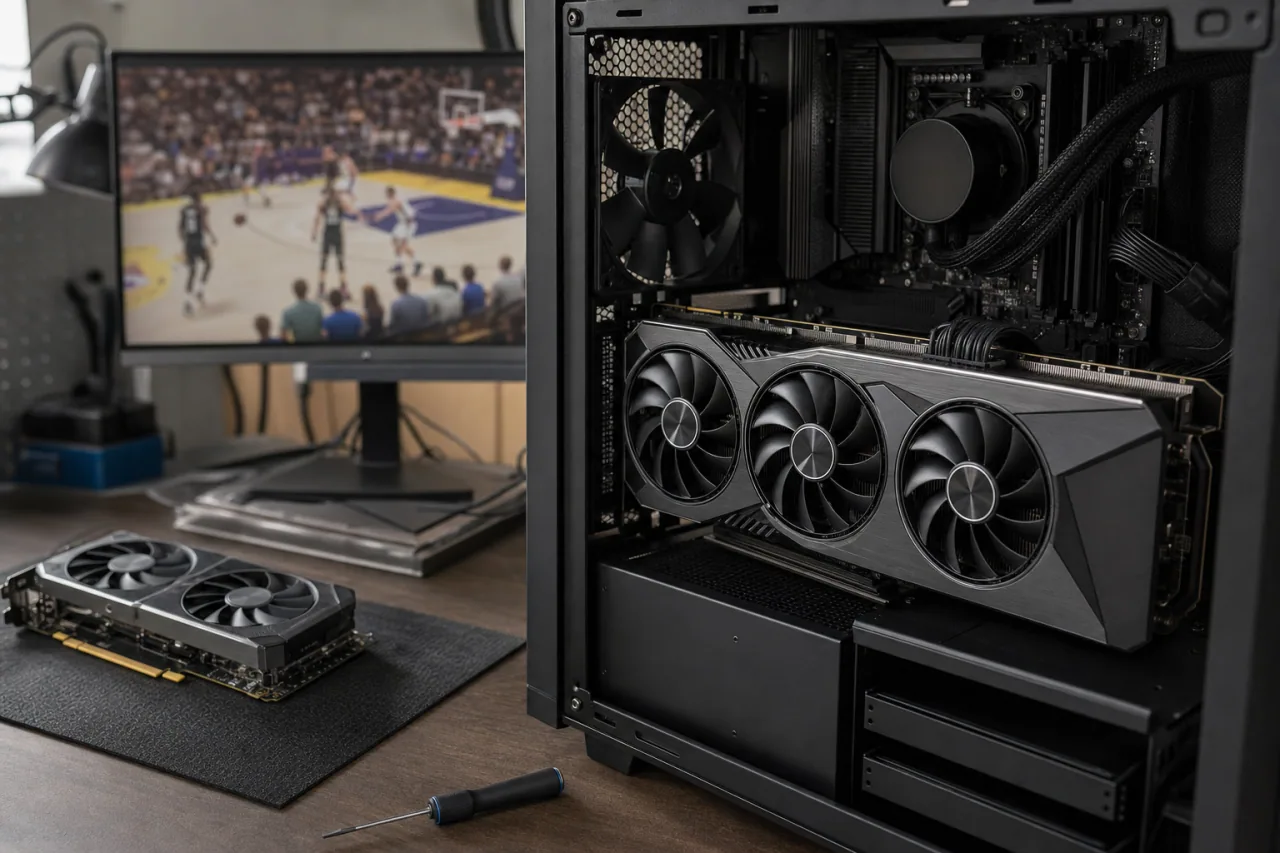
That distinction matters. Earlier upscaling approaches have generally been understood as techniques to reconstruct a higher-resolution image from lower-resolution rendering. DLSS 5’s generative-AI positioning raises a more contentious question about how much of the displayed action must be conventionally rendered versus synthesized.
Why the rollout matters
The hardware requirement gives Nvidia a clear commercial lever. DLSS 5 is initially limited to its RTX 50-series GPUs, creating a feature boundary between new systems and prior generations. GeForce Now provides an alternative route for customers without local RTX 50-series hardware, but it also keeps the experience inside Nvidia’s cloud ecosystem.
For game operators and publishers, the initial deployment offers a controlled setting. A single high-profile release can expose issues around visual artifacts, responsiveness, competitive play and player trust before the feature reaches a wider catalog. Sports games are particularly revealing because players can quickly notice inconsistencies in movement, ball trajectories, camera motion and animation.
For PC builders and hardware retailers, the launch may become another reason for enthusiasts to consider RTX 50-series equipment. But adoption will depend on benefits that players can readily see and feel, not on a feature label alone.
The business question: performance or perception?
Nvidia has long used DLSS as both a performance technology and a differentiator for its GPU lineup. DLSS 5 extends that strategy, but it also introduces a reputational risk: players may reject a graphics feature if they believe it compromises visual fidelity or gameplay clarity in pursuit of higher frame rates.
Developers face a related tradeoff. AI-based rendering tools can potentially help target demanding visual settings across a broader range of performance conditions. Yet implementation comes with QA demands, user-experience scrutiny and the need to communicate clearly about what the system does. In games where timing and competitive integrity matter, perception can be as consequential as benchmark results.
What to watch next
The September 3 release of *NBA 2K27* will provide the first practical signal on DLSS 5’s launch quality. Watch for independent testing of image behavior and responsiveness, player reaction to the feature, and whether Nvidia quickly announces additional supported titles.
The larger test is whether DLSS 5 becomes a standard graphics option developers embrace—or remains a technically ambitious feature constrained by hardware requirements and skepticism over generative rendering in games.